Mominette

Mominette by Maxou Heintzen might sound a little familiar if you know the tune The Plane Tree, which is a jigged version of this same tune that is attributed to whistle player and piper Undine Hornby. It is a potential mate for Will’s Way, with other contenders including Harlequin Air – as and when we decide (depending on whether it’s a simple arrangement for dancing to or a complex arrangement for concerts), we will add some alternative chords. Here is a fabulous recording of the tune by Blowzabella.

Coronation Day

Here are the dots and video for these week’s new tune, Coronation Day. This tune is in the 1698 edition of Playford’s Dancing Master collection (the first edition dating back to 1651) but not in the previous 1695 edition – this suggests that the coronation in question may have been of William and Mary, there having been a recent revolt against their predecessor James II and VII.

Here are the three versions of the chords that we tried, with a reminder that in experimenting, we’re not looking for one definitive set of chords but rather for different versions that contrast and give our arrangement light and shade, variety, a sense of direction etc.

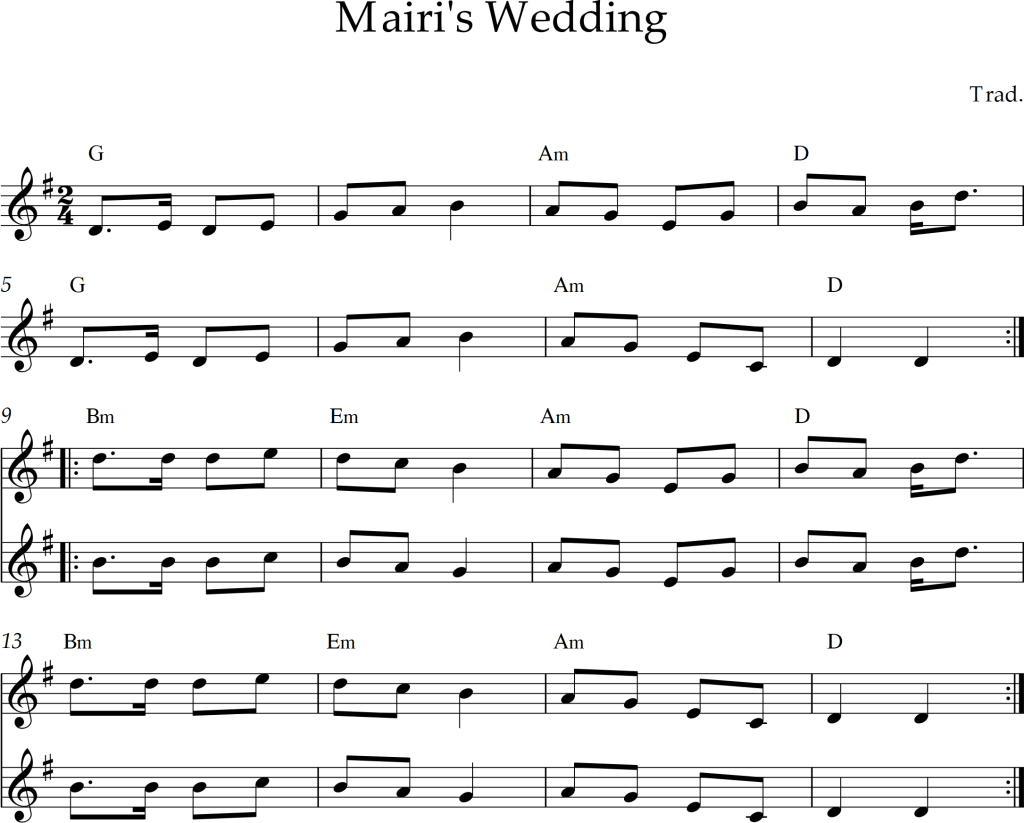
Mairi’s Wedding

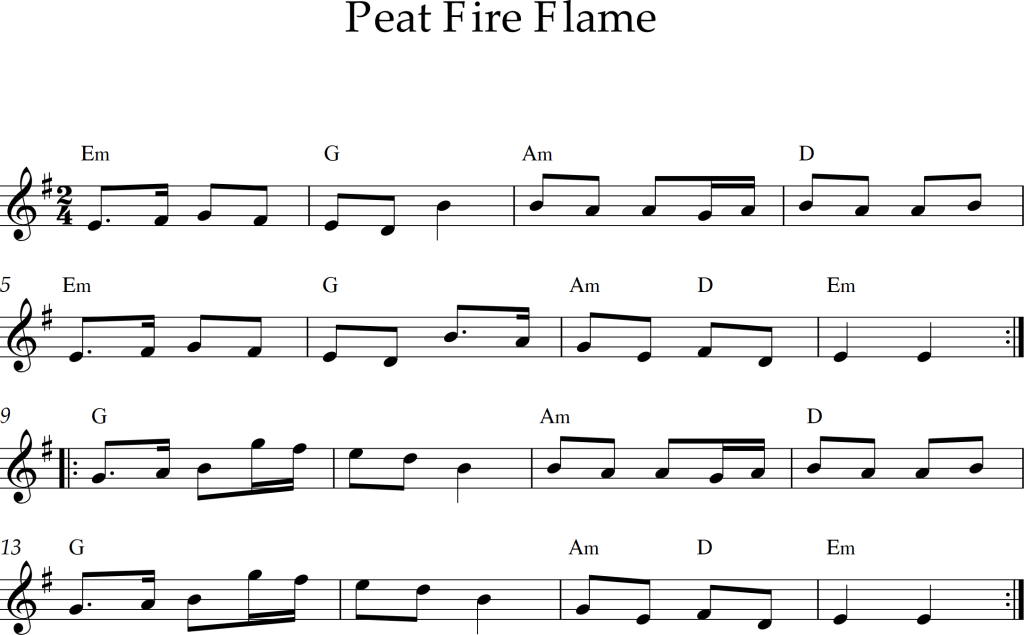
Here is the tune from Monday 31st, Mairi’s Wedding, aka The Lewis Bridal Song, or Jack Sweeney’s. This Scottish tune was first published in 1909, as is normally described as a Scottish/Scots Measure, this being a tune related to a reel but with more quavers if written in 2/4, or crotchets if written in 4/4. It is a popular tune for Scottish Country Dancing, with the well known words being added in around 1935. We will use this as the opening tune in a set with Peat Fire Flame.

Here are the dots and PDF:

Ladies Pleasure (Fieldtown)

Here is the video and dots for Ladies Pleasure, a tune from the Fieldtown Morris tradition and one that changes meter from 6/8 to 2/4. The ‘2’ over the patterns in bar three (and elsewhere) indicate a duplet, so instead of each main beat dividing into three quavers as it would normally in 6/8, it divides into two quavers.

Here is the video:

Here are the dots – the structure would normally be ABCBCB.

Uncle Bernard’s Development

Here is the development of Uncle Bernard’s, transposing the tune down a minor third to the relative minor of E minor. Since the tune starts and finishes on the tonic (G in G major or E in E minor) and moves mostly in small intervals, we were able to move it down without making very many changes – we only tweaked bar 30 (middle of the B section), bringing the melody down to an E rather than sticking on the G. In the video below I have included the version notated and then a version without the adjustment.

This new version can be played as a complete tune in its own right, or added to the end of the major version as C and/or D sections.

Here is a PDF: