Picking Up Sticks, or The Picking of Sticks, is a Playford tune and is in the earliest editions of the manucript from 1651, though only the A part is listed. It’s not clear when the B part came along, though it’s in a rough and undated manuscript by Sabine Baring-Gould (1834-1924).
Here is the video for Picking Ups Sticks, with thanks as always to Mary D.
Here are the dots – we learned the tune, and named the melodic figures ‘runs’, ‘hills’ and ‘skips’ before paring the tune back to the bare bones and reordering the figures to create variations.
There is a PDF of the tune and chords here, for those who can’t print the graphics file.
Here’s Kit White’s no. 2, a tune I know from various sessions. I’ve had trouble tracking down who Kit White was or is – it’s not a good phrase to Google, though if you need a teeth whitening kit then I can tell you that have lots of options available, see also the drummer from the White Stripes and white football uniforms – and the Vaughn Williams Library archives (one of my ‘go to’ sources) doesn’t have any records of either the tune or the person. I have however found him listed as performing melodeon on a recording of traditional music from Yorkshire made in 1950, so that’s a start! My version differs slightly from some of the notated versions I’ve found, as so often happens in traditional music. Here’s the video, with a slow version, a faster version with variations and the chord rhythm:
Here are the dots for the standard version of the tune:
The variations we tried involved switching the rhythms around in the A and B parts, and using the chord rhythm:
This info for those of you that might be interested:
GOLDFISH FOLK CHOIR ON THURSDAY 17 JANUARY
Join us for weekly harmony singing; there’s no need to read music as everything is taught by ear. We sing rounds, ditties and folk songs – anything from Sea Shanties to Bob Dylan. Please get in touch if you have any questions at all.
Thursdays, 19:00 – 20:30 £6 on the door
The Grosvenor Pub (Upstairs) 127 Oaklands Road, Hanwell, W7 2DT
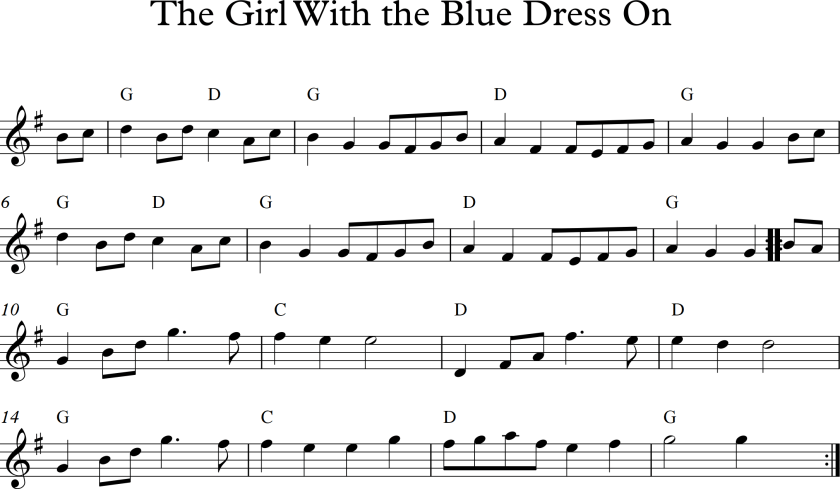
‘The Girl With the Blue Dress On’ is a chirpy polka that turns up in English and American traditions as a ceilidh tune, contra tune and as a North-West Morris tune.
There is a simplified version here, and a more decorated version written out in full with the ‘tumbles’ (embellishments at the end of phrases that connect up the different sections) and the alternative chord sequence here.
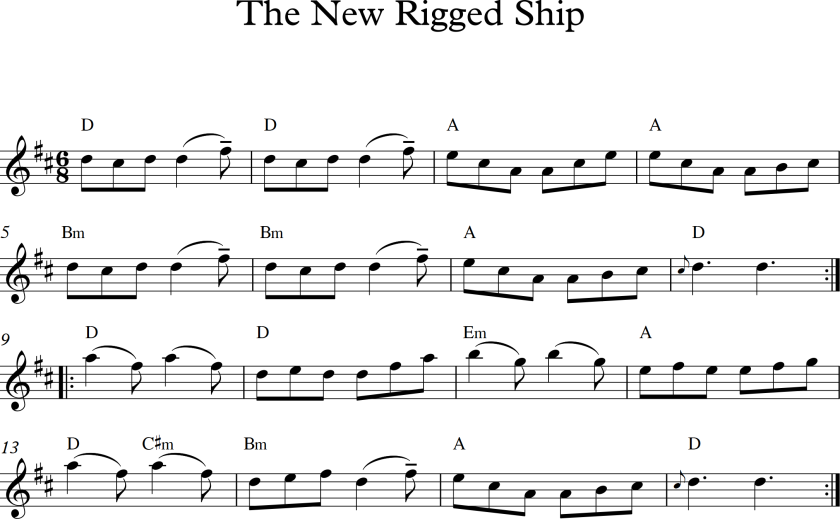
Welcome back! Here’s the New Rigged Ship no. 1 in D major. I have found this tune in several sources, the earliest of which is an 1800 edition of Thomas Hardy’s manuscript (from Dorset), it also pops up in an 1853 Scottish book ‘Hamilton’s Universal Tune Book no.2’ and there’s an 1908 version collected in Derbyshire titled ‘The Man Who Couldn’t Get Warm’. There are both reels and jigs from the Shetland Isles called ‘Da New Rigged Ship’ or the ‘Da Full Rigged Ship’, however these do not seem to be related!
The warm ups and drills we started with are on a new page that you can find on the top menu – the main thing to note is that this tune contains lots of 3rds (that is to say a small jump of three notes), for instance in the D to F#s in the first two bars of the A section, and in bars 9 and 11 of the B section. This is a really handy interval to listen out for – think ‘cuckoo!’ – and it gives us lots of scope for variation!
We started by filling some of these 3rds in with the ‘missing’ notes (see HERE for a written variation).
We then took a load of notes out to create more space, before adding some slightly different patterns back in (see HERE for the written variation).
Please note that these variations are designed as a starting point, recapping some of the ideas we covered in class, and are not supposed to be a perfect examples although I have tried to make them at least reasonably musical! Other possibilities for melodic variation could include playing down the octave, or varying the order of the notes in repetitive sections, for instance in bars 3 and 4 of the A section.
Happy New Year everyone! Our new term will start on January 7th , running through to March 25th but with no class on February 18th. Same time, same place – see you there!
Next week, December 10th, will be the last session of term and we’ll mark it with an informal concert and session at the Trade Union Club. Please invite your friends and family – we’ll meet as usual at 7:15 for a quick rehearsal, and then play some tunes for our audience at 8. After that we’ll retire downstairs for a session. Rather than selling tickets, I suggest we take a collection at the end which will then go to a local charity for the homeless. There may even be a raffle! Hurrah!
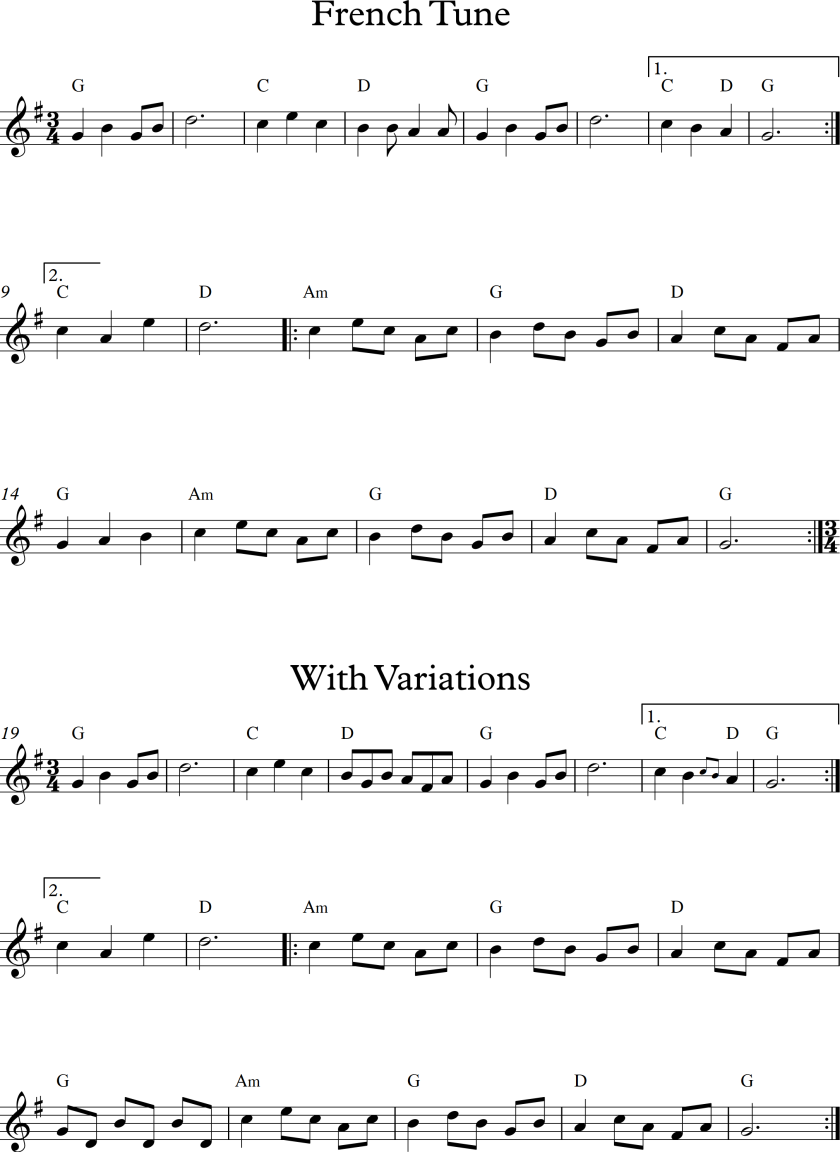
This is most likely La Marianne, though I have always known it as Madelaine, possibly a fancier version, or a mishearing, but anyway – here it is! PDF here, and video and dots below.
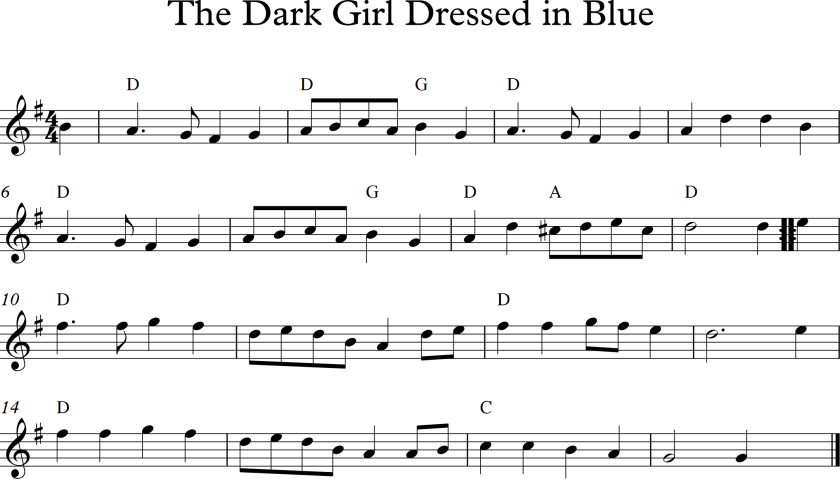
Here are the dots, PDF and video for the Dark Girl Dressed in Blue, also known as The Duchess (at least to me and Kerry Fletcher, can’t find it listed as this anywhere else!) and as Over the Waterfall in Old Time circles, albeit with the A and B sections reversed. There appears to be a song version of the tune dating back to about 1850, with lyrics by music hall star Harry Clifton (1824-1872), though recordings I can find are to a slightly different though seemingly related tune.



 New Ealing Sessions