Swanton Abbot Hornpipe

A tune from Norfolk, the Swanton Abbot Hornpipe (originally just called Hornpipe) collected by George Watson in the late 1800s. There is a nice write up on the Village Music Project website about the Watson collection, for anyone who’s interested.

You’ll notice that the chords don’t resolve the D at the end of each section – this is on purpose! We often think of a 32 bar tune as being just that but in reality the tune will be played four or five times in a row, and so the constant return to the tonic key at the end of each section can become somewhat tedious. While we won’t use the G chords every time, this serves as a reminder to think of the whole arc of the repeated tune and not just the short, written down tune that we see in the notation.

Here’s a fantastic version of the tune by Nick Wyke and Becki Driscoll

https://nickwykeandbeckidriscoll.bandcamp.com/track/george-watsons-hornpipe

And a very different version by Dave Shepherd:

UPDATE:

Here’s a PDF of the accompaniment pattern, with its stereo effect:

and a video of the accompaniment alone (beginning) and with the tune (from 1:46) – my phone hasn’t picked up the pattern very well, but you can hear it in places.

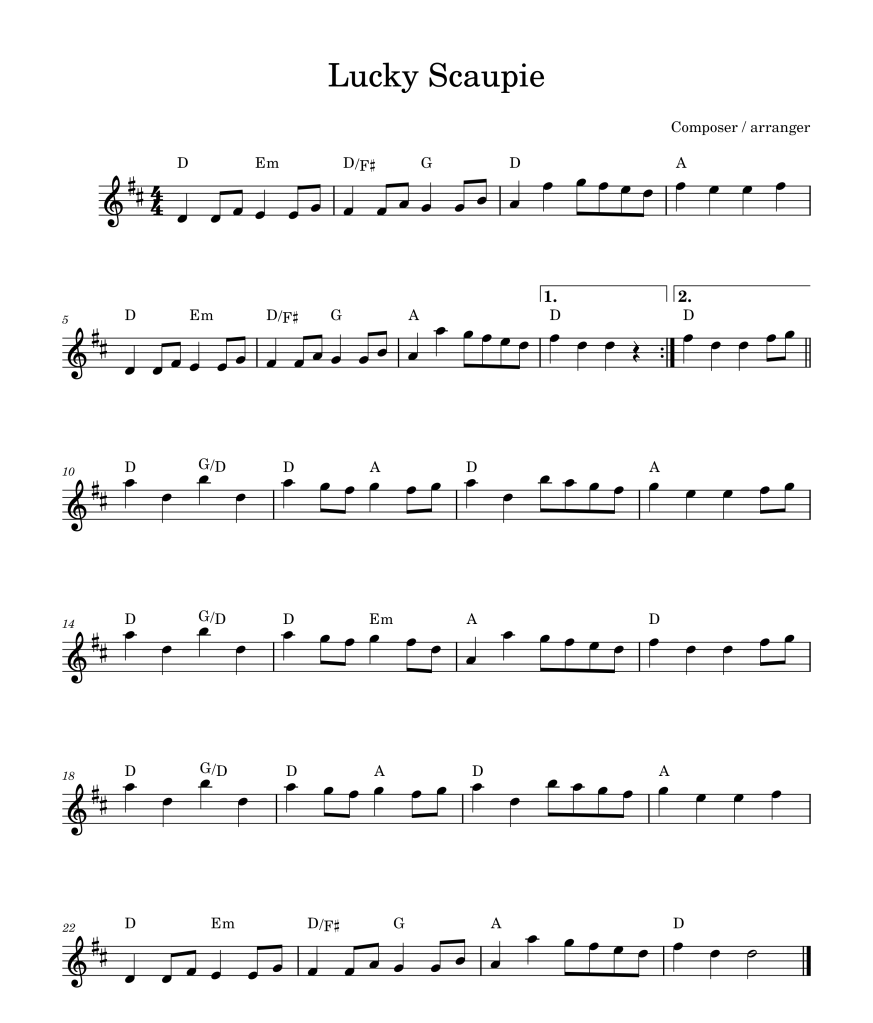
Lucky Scaup

A cheerful tune to start back, this is Lucky Scaup, or Lucky Scaupie, a Scottish tune that I got from a Jimmy Shand album.

I believe that Lucky Scaup refers to an old Folly in Tayport, near Dundee. It was built in the 1860s and demolished in the 1979 when it had become unstable and potentially dangerous.

The structure is AAB, as the B section is long and references the A at the end. The D/F# chords (and others in this format) mean play a D chord with an F# in the bass if possible.

Here is the recording I learned it from, our tune starts at 1:08.

The Bath Hornpipe

Welcome back! We started the term with a jolly, bouncy tune called The Bath Hornpipe, from a manuscript of collector Frank Kidson. This tune turns up in various Yorkshire collections from around the 1840s and 1850s, sometimes under this title and sometimes as Newton’s Hornpipe. We are playing it as a dotted hornpipe… for now!

Here are the dots and video: