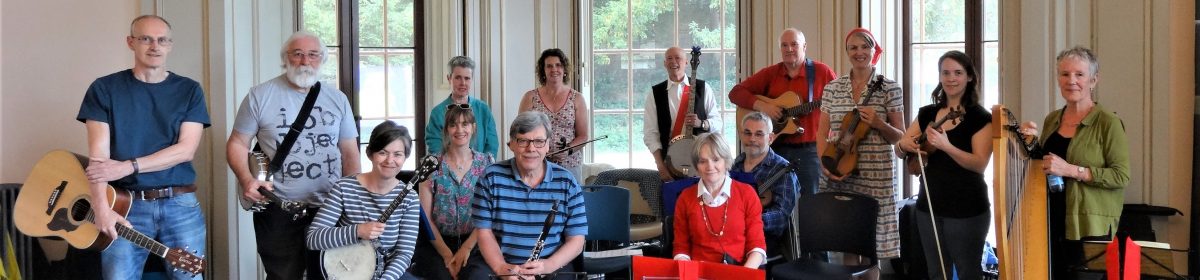
Deborah is a violinist and violist specialising in English folk music. She trained in viola and Baroque viola at Birmingham Conservatoire, before returning to her first love of traditional music, song and dance.
Deborah has developed a passion for playing for dancing since joining her first ceilidh band at age 13. She is a member of Stepling, a band performing English music, step-dance, song and percussion, and also plays with Folk Dance Remixed, a dance company combining traditional dance with hip hop and street dance styles, with whom she has performed as such events as Car Fest, the Southbank's Festival of Love and Glasgow's Commonwealth Games Festival.
Deborah records on a regular basis for a number of people, including The Mystery Fax Machine Orchestra, and for Laurel Swift's 'Travelling with Thomas' musical.
She teaches music, song and dance regularly for The English Folk Dance and Song Society, as well as on a freelance basis for various workshop series, festivals and music services. Deborah recently completed The Teaching Musician MA degree course at Trinity Laban, graduating with Distinction.
Here is an update of the Constant Billy sheet, with the two new riffs at the bottom. The second PDF below contains the chord sequences and the arrangement that we started on the 12th. The video is of the unrehearsed arrangement that we tried out – it’s not exactly what’s written on the arrangement sheet now, but should give you a feel for the whole piece.
Here is the recording of Coronation Day tune with the phased rhythmic ostinato that we used in the warm up, inspired in part by Steve Reich’s Clapping Music which was in turn partially inspired by flamenco music.
Here is a video of Clapping Music with a useful graphic to help you see what’s going on. The pattern is repeated eight times before the lower part phases by one quaver.
This week’s tune is English Morris dance tune Constant Billy. There are versions in most of the different Cotswold Morris tradition in various keys, though often transposed into G major to suit the commonly used melodeon. We made two different versions of the chords, the first being a conservative version that harmonises every half bar and the second a more contemporary version that harmonises every full bar. To refer back to our inspiration arrangement, Coronation Day, we have used/tried:
long notes that can also be used as in a shuffle rhythm
Playing the tune with a pedal G (tonic) underneath throughout, and also trying a pedal D (dominant) throughout
Using a chord sequence that doesn’t resolve to the tonic of G at the end of each phrase (from the long notes pattern)
We will look at long and short ostinati next week and use these to make an intro/outro for the whole piece, also extending the tune by developing certain phrases.
Here is the video, with the second version of the chords:
I’m not going to put up dots for the arrangement we tried last week as we have used the Nick Wyke and Becki Driscoll arrangement as a base and that is not mine to share! The elements we have taken from it to use this week are:
a long ostinato that goes over two bars
a short ostinato that cycles over three bars
long notes that can also be used as in a shuffle rhythm
Playing the tune in unision/octaves with no chords
Playing the tune with a pedal G (tonic) underneath throughout
Tune with chords as devised lat week, including a pedal D chord (dominant) that mirrors the tonic pedal that we also tried
Extending the tune by repeating one phrase several times
Using a chord sequence that doesn’t resolve to the tonic of G at the end of each phrase (from the long notes pattern)
Book-ending the tune with intro and outro sections that are very similar
Here are the dots and video for these week’s new tune, Coronation Day. This tune is in the 1698 edition of Playford’s Dancing Master collection (the first edition dating back to 1651) but not in the previous 1695 edition – this suggests that the coronation in question may have been of William and Mary, there having been a recent revolt against their predecessor James II and VII.
Here are the three versions of the chords that we tried, with a reminder that in experimenting, we’re not looking for one definitive set of chords but rather for different versions that contrast and give our arrangement light and shade, variety, a sense of direction etc.
Here is the tune from March 6th, The Valiant by East Anglian musician Simon Ritchie. We experimented with adding linking notes between sections – an A between the last C section and the first A section, an F# or a D between the C sections, and a BC run between the Bs. I’ve included some of these on the music, but have an experiment and see what else you can find.
Here’s a video of Kafoozalum by the incredible Bellowhead (both the tune and the song, the version with clean words that is):
Here are the dots, with examples of bowing, chords and a harmony. Apologies for the image quality, I am having to use new software and I haven’t yet found a good way of generating a good picture!