Deborah is a violinist and violist specialising in English folk music. She trained in viola and Baroque viola at Birmingham Conservatoire, before returning to her first love of traditional music, song and dance.
Deborah has developed a passion for playing for dancing since joining her first ceilidh band at age 13. She is a member of Stepling, a band performing English music, step-dance, song and percussion, and also plays with Folk Dance Remixed, a dance company combining traditional dance with hip hop and street dance styles, with whom she has performed as such events as Car Fest, the Southbank's Festival of Love and Glasgow's Commonwealth Games Festival.
Deborah records on a regular basis for a number of people, including The Mystery Fax Machine Orchestra, and for Laurel Swift's 'Travelling with Thomas' musical.
She teaches music, song and dance regularly for The English Folk Dance and Song Society, as well as on a freelance basis for various workshop series, festivals and music services. Deborah recently completed The Teaching Musician MA degree course at Trinity Laban, graduating with Distinction.
Here’s the video from Dave’s session on April 8th, with apologies for the delay in posting. Here’s the tune:
…and here’s the chord part:
The dots for this tune can be found by clicking here. Massive thanks to the incredible Dave Delarre for this great session, and I’ll be back for the beginning of next term on April 29th.
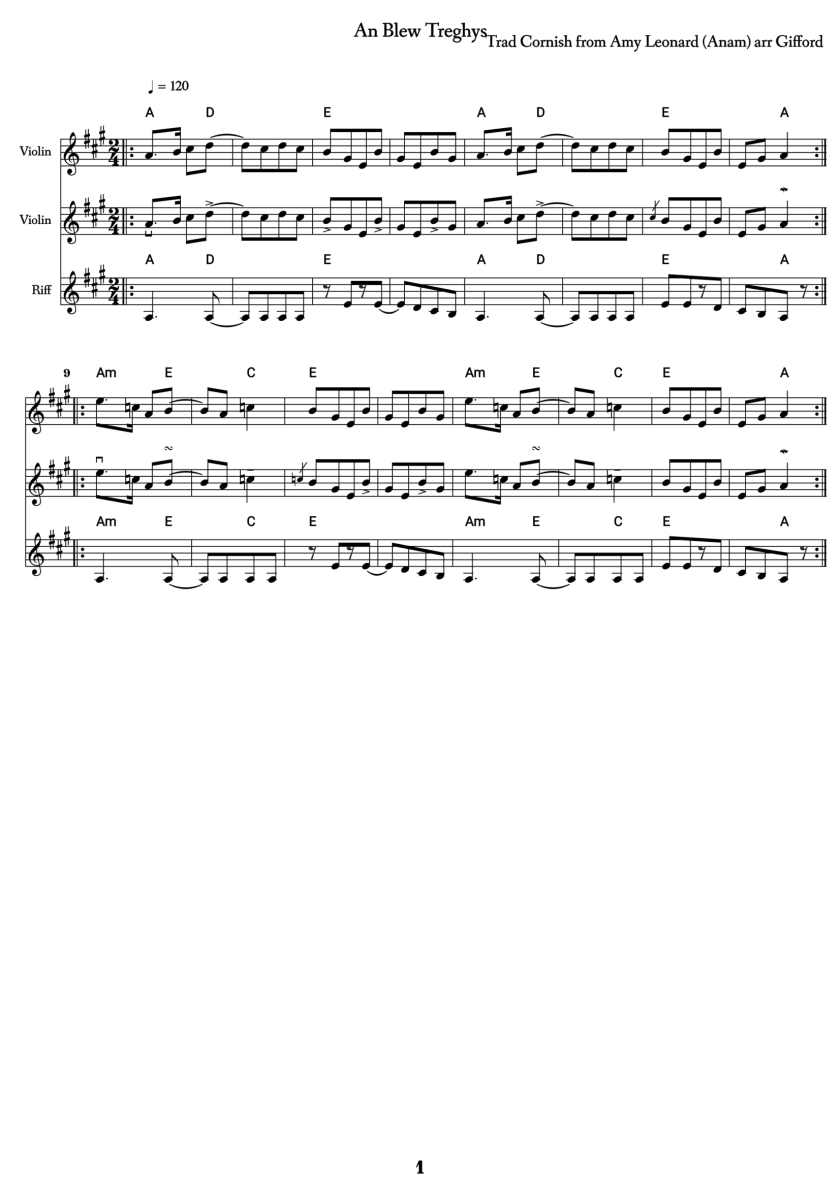
Here are the video and dots for An Blew Treghy, with huge thanks to Beth Gifford for covering the class. An Blew Treghys is a Cornish Tune which Beth learned from the singing of Aimee Leonard and recorded by Aimee’s band Anam on their album Riptide.
This week we’ll spend the first half of the evening upstairs learning some basic arrangments of tunes from this term before coming down to the bar and sharing them in an informal concert, after which we’ll have a bit of a session. Here is a file of the arrangements, for anyone who wants to try them out or print them beforehand.
For the following two weeks we’ll have guest tutors Beth Gifford (April 1st) and Dave Delarre (April 8th). There will then be a break for Easter, with classes resuming on April 29th.
Here’s the video of The Bonny Pit Laddie, a song/tune from Northumbria, printed in the 1882 Northumbrian Minstrelsy, with earlier versions printed elsewhere in 1812 and 1770.
In the version I know, each line is sung twice, meaning that you’ll get through the tune twice, but in others I’ve found the second and fourth lines are follow one another making up one B section:
The bonnie pit laddie, the canny pit laddie, the bonnie pit laddie for me, oh (x 2)
He sits in a hole as black as the coal and brings the bright silver for me, oh (x 2)
The bonnie pit laddie, the canny pit laddie, the bonnie pit laddie for me, oh (x 2)
He sits on his cracket & hews in his jacket & brings the bright silver for me, oh (x 2)
The pit in question would have been a coal mine, and the ‘bright silver’ refers to money earned. For those of you in education, or for anyone who wants to know more about mining songs, there is a great digital info pack available from the EFDSS website here.
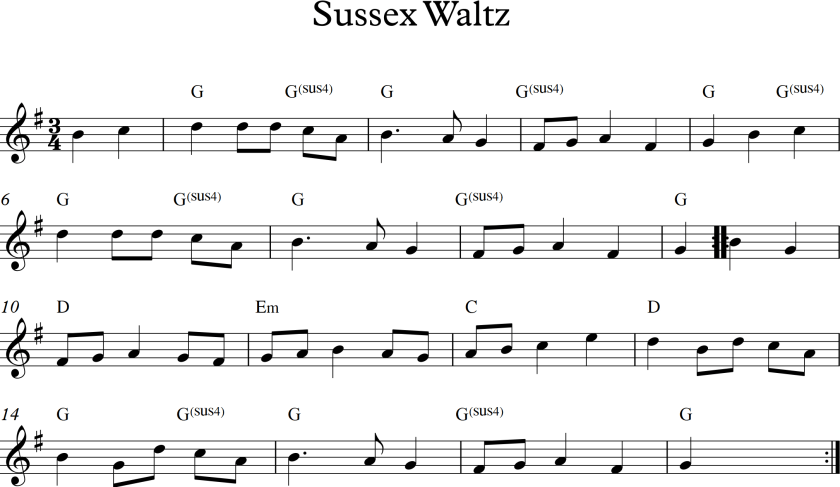
Here is the video for this week’s tune, Sussex Waltz. It first appears in print as ‘Untitled Waltz’ in the 1800 Welch manuscript from Bosham in Sussex.
Here are the dots for the tune, with a PDF file here:
For a version with some variations and ornaments, and with an alternative chord sequence in the B part, here.
Here’s Small Coals and Little Money, a tune from the 1882 Northumbrian Minstrelsy manuscript. The A and B parts are almost identical so we created variation by varying the chord patterns and rhythms, taking out some notes in the melody, and trying out ornamentation.
In the chord part, we used a ‘chugging’ rhythm for the A part, and then a more relaxed rhythm in the B part.
Melody instruments created a groove for the A part by switching between A minor and G major notes (click here for the chart, the beats are minim beats, so 2 slow beats per bar).
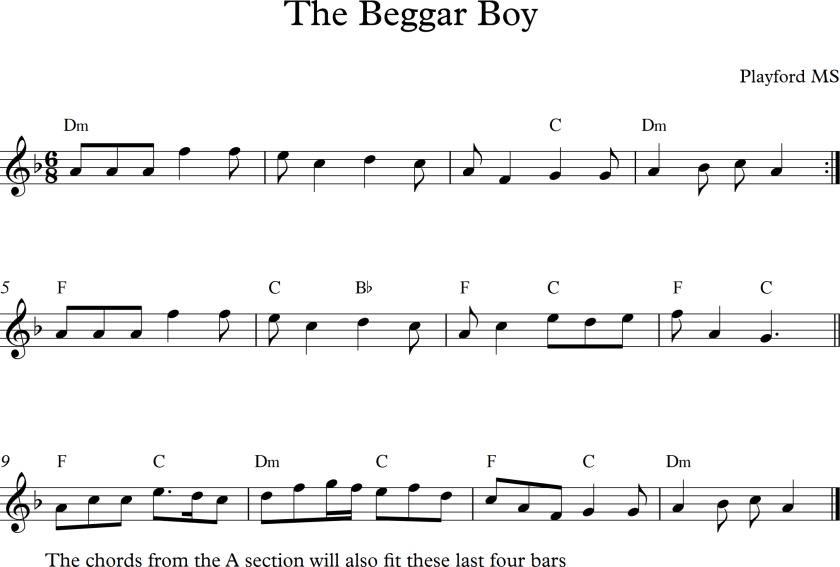
Here’s the video for Playford tune The Beggar Boy, from the 1651 manuscript – it was included in subsequent editions right through to the 7th in 1686, and Chappell (1859) notes that there are several ballads written to the tune, as tended to happen with popular tunes.
And here are the dots:
Here are the dots, for those who want to print them out.
We created contrast between sections with drone-like minor chords in the A section and swifter changing major chords in the B section. I’ve tagged the tune as both major and minor as it can be harmonised as either, giving a different character.
We created a groove for the A section by picking out notes from the D minor and C major triads. Since Dm and C are neighbours, it’s possible to move between the chords in a scale pattern. Here’s a link to a chart explaining this: for each of the main beats listed at the top, pick a note from the coloumn beneath. There is an example of how you could do this at the bottom, with notes highlighted in red. You might want to print this sheet out and circle one note in each column to create your own part.
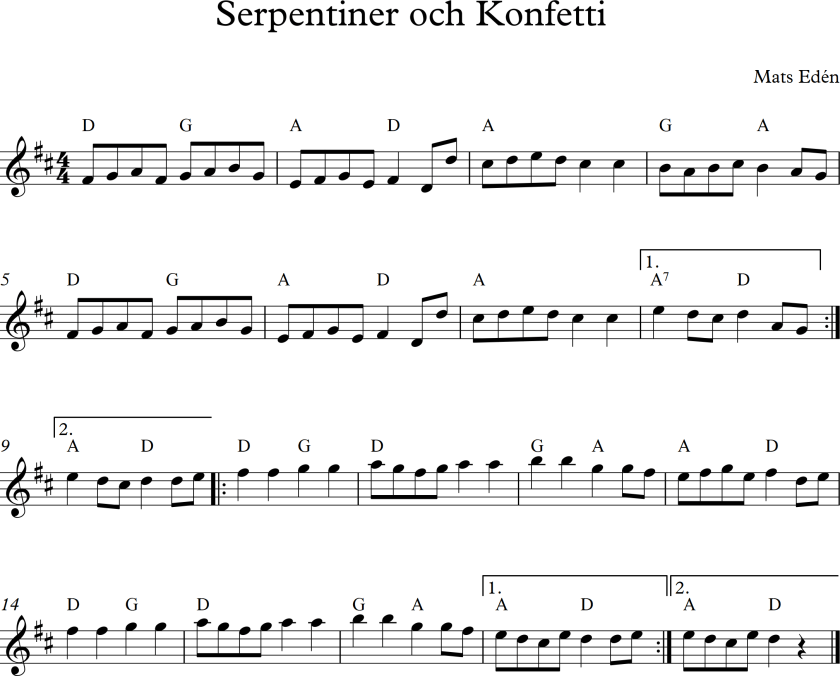
Serpentiner och Konfetti (Streamers and Confetti) is a fantastic reijländer tune by Swedish melodeon player Mats Edén. We’re not trying to play it in a particularly Swedish way, also I somehow only played the B section once on the video – apologies, it had been a long day!
Here are the dots for the tune:
We varied the rhythm by anticipating (or ‘pushing’) some of the main beats in the melody and also in the chord sequence – dots can be found here.


 New Ealing Sessions