Accompaniment patterns for Mynnyd Yr Heliwr

We tried three different accompaniment patterns for our tune, with an alternative set of chords from week one – each player picked a note from each chord, linking them together to create their own personalised part.

Looking at the PDF below, A is the short stabs, B has the overlapping patterns used earlier in the term and C is the feature rhythm for the A section only. All are illustrated with the A section and the notes used are also illustrative, please use your own chosen notes:

Tune with new chord sequence:

Extra task: try playing the tune in a different key, specifically A minor. Why?

1. Many tunes have more than one ‘standard’ key that they tend to be played in, and so being able to switch into a different key is a very useful skill to have in any setting. Examples of this are Cock of the North (G/A/D), Jump at the Sun (Gm/Em) and Mrs McCloud’s (G/A mixolydian).

2. Thinking in terms of intervals rather than in terms of fingerings/notes will make you more flexible as a musician. It’s good for your brain! I don’t expect many of you to be able to get it perfect first time, that’s not how learning music works, but practising this skill will also help to get the tune firmly into your memory banks.

The Rights of Man

The tune from June 9th, as requested by Mary D, The Rights of Man. This is a hornpipe that was first published in the 1870s, it’s played widely across Ireland, Scotland and England. I’ve included two chord progressions (as PDFs), we will examine the effects of these next week, amongst other things.

Here’s a video (with focus on violin left hand) with some of the variations we tried, there are also some interesting sound recordings on the TuneArch.org page.

Tobin’s Jig and Hardiman’s Fancy

NB. Hardiman’s now has updated chords.

When playing Tobin’s Jig last week, we initially struggled to give the tune a sense of lift, lilt or dance – our solutions were:

  • Have the long line of each four-bar phrase our heads before we started, with it’s peaks and troughs. This got us away from focussing too much on the individual notes and patterns, and from the mechanics of playing this tune on our respective instruments.
  • Add some subtle dynamics – we followed the rise of the melody with a small crescendo (gradual increase in volume) and the fall of the melody with a diminuendo (gradual decrease in volume). Subtle is the operative word here! It isn’t always the case that we need to rise and fall with the melody, this can become a little obvious and predictable, but the idea is that we’re giving an additional dimension, or melodic shaping, to the tune.
  • Add some slurs over the bar lines (this is updated on the original post) – this can give the sense of moving forward across the bar line, with some very subtle syncopation in the phrasing.

Playing with the tunes

Monday saw us adding a riff to Old Meddon (dots and PDF are updated) and trying Jigolo in A major (A major version in PDF under dots). We looked at the patterns of scales, arpeggios and sequences in Jigolo and used this to go from G major to A major. Useful questions included: which degree of the scale does the tune start on (A part and B part)? In bar 7-8, which degree of the scale does the descending scale start on?

Some tunes have set keys that they are typically played but others can vary. I’ve played Jigolo in both G and A major at various sessions, for instance. It’s therefore a useful skill to be able to play tunes in different keys – it also helps to fully internalise each tune, to cement the tune in one’s memory, to make sure you know the tune inside out. Certain ornaments, variations and bowings will be easier on different notes in particular keys, and certain keys are more or less resonant on different instruments. Exploring a tune like this helps to get it in your memory long term – which of the tunes in your repertoire can you play in different keys?

Hunt the Squirrel

Hunt the Squirrel is a fantastic and widespread tune, with many different versions (I know three different versions of the B part!) and it dates back to at least the mid 1700s.

We will use this tune in our forthcoming appearance at Ealing Country Dance Club, pairing it with Dory Boat.

The alternative arrangement for Hunt the Squirrel was drone G/D for whole A part and drone G/E for 1st half of B then return to G/D, some melody players play an octave lower. The alternative arrangement for Dory Boat was using a simplified B part (removing notes) and some melody players playing the root notes of the chords. Please make your own notes/references for this!

Constant Billy arrangement ideas

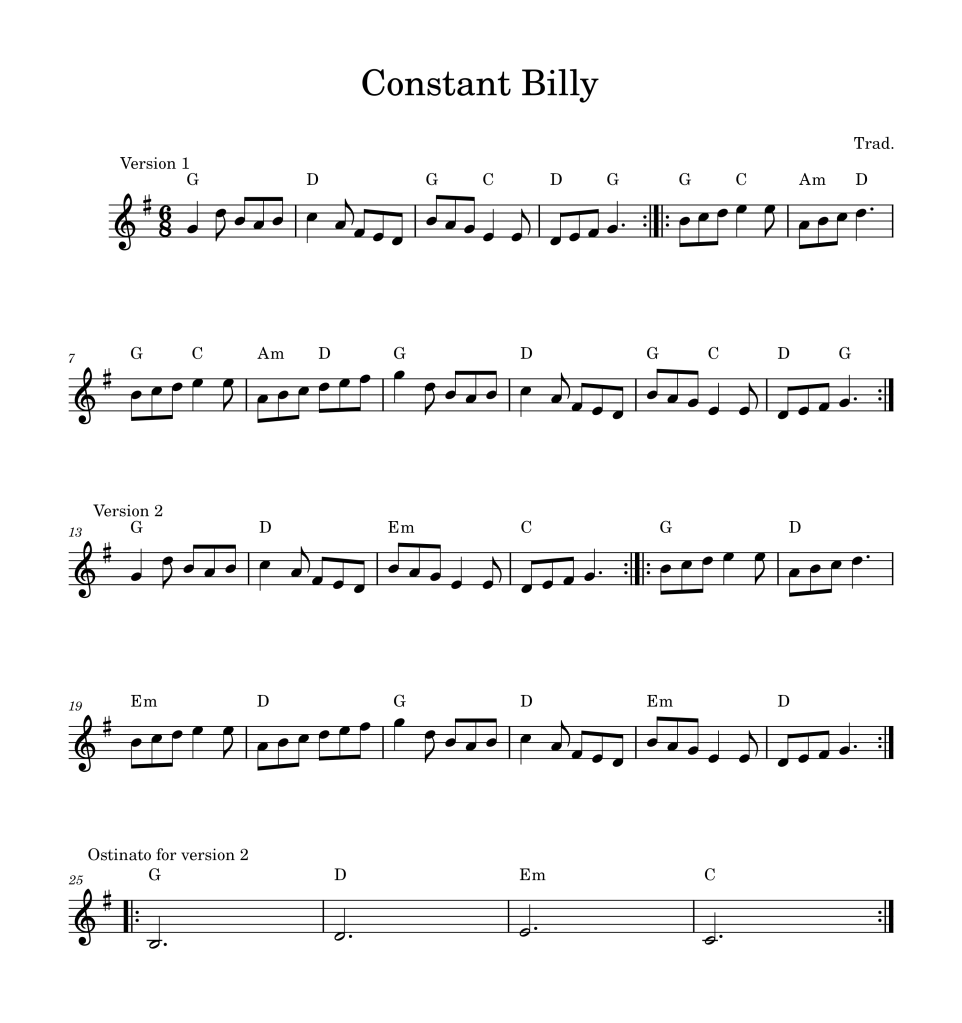
Here is an update of the Constant Billy sheet, with the two new riffs at the bottom. The second PDF below contains the chord sequences and the arrangement that we started on the 12th. The video is of the unrehearsed arrangement that we tried out – it’s not exactly what’s written on the arrangement sheet now, but should give you a feel for the whole piece.

Coronation Day: more arrangement ideas

Here is the recording of Coronation Day tune with the phased rhythmic ostinato that we used in the warm up, inspired in part by Steve Reich’s Clapping Music which was in turn partially inspired by flamenco music.

Here is a video of Clapping Music with a useful graphic to help you see what’s going on. The pattern is repeated eight times before the lower part phases by one quaver.

Constant Billy

This week’s tune is English Morris dance tune Constant Billy. There are versions in most of the different Cotswold Morris tradition in various keys, though often transposed into G major to suit the commonly used melodeon. We made two different versions of the chords, the first being a conservative version that harmonises every half bar and the second a more contemporary version that harmonises every full bar. To refer back to our inspiration arrangement, Coronation Day, we have used/tried:

  1. long notes that can also be used as in a shuffle rhythm
  2. Playing the tune with a pedal G (tonic) underneath throughout, and also trying a pedal D (dominant) throughout
  3. Using a chord sequence that doesn’t resolve to the tonic of G at the end of each phrase (from the long notes pattern)

We will look at long and short ostinati next week and use these to make an intro/outro for the whole piece, also extending the tune by developing certain phrases.

Here is the video, with the second version of the chords:

Here are the dots: