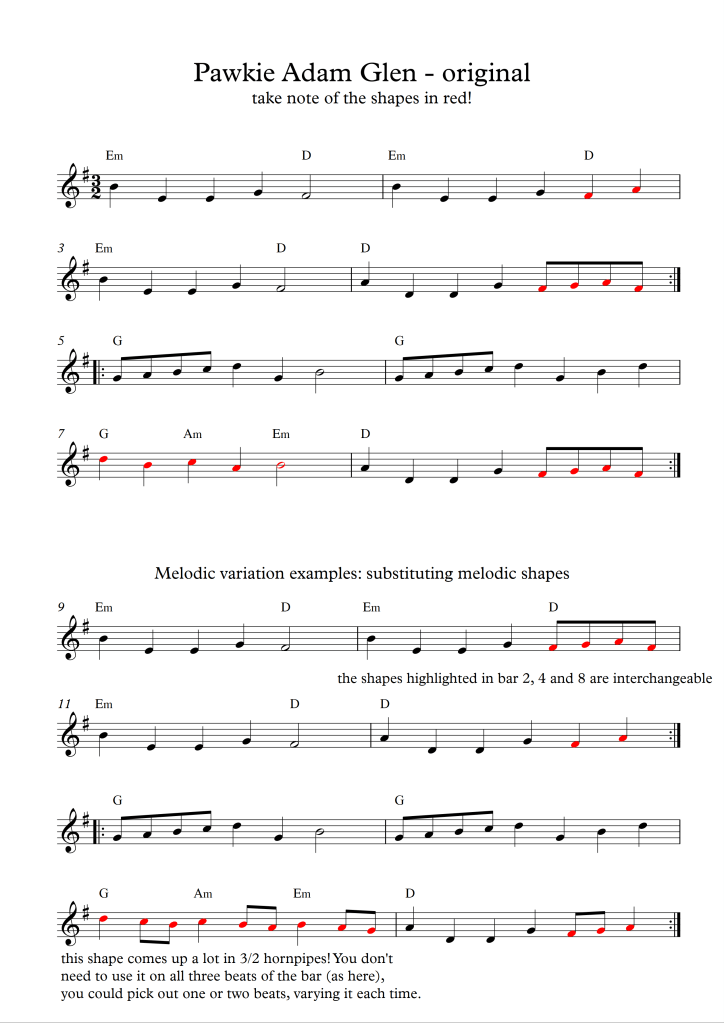
In addition to the rhythmic variations we covered last week, there are some nice melodic variations available in this tune. Our first idea was to substitute existing melodic shapes for others in the tune, for example in bars 2, 4 and 8. The second involved substituting a figure that often comes up in 3/2 hornpipes. Have an experiment, try these and the rhythmic variations and find what works for you!
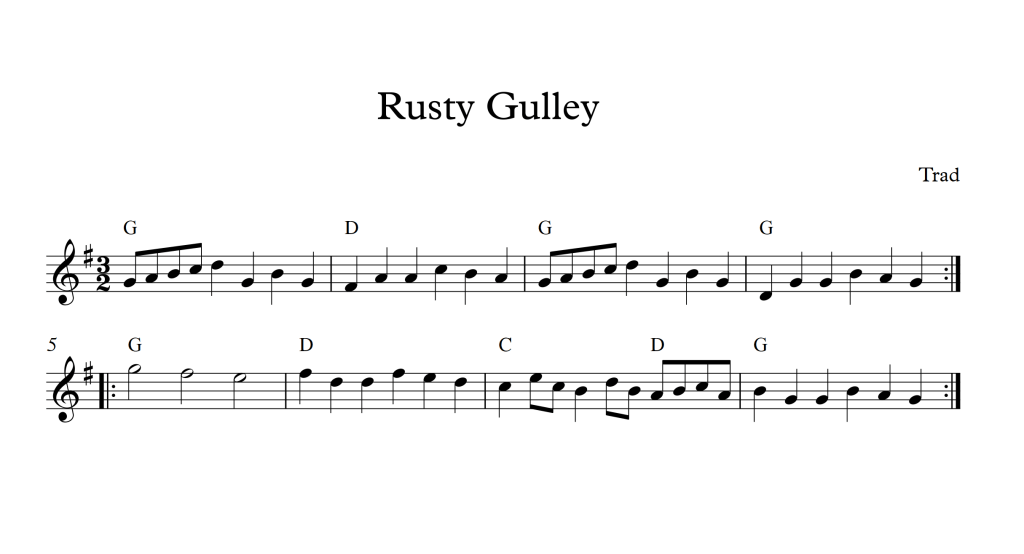
Here’s another 3/2 hornpipe to go with Rusty Gulley, known as ‘Adam Glen’ or ‘Pawkie Adam Glen’ – the word pawkie means ‘artfully shrewd’ and is still in use in Scotland and northern parts of England, from the English ‘pawk’, meaning trick.
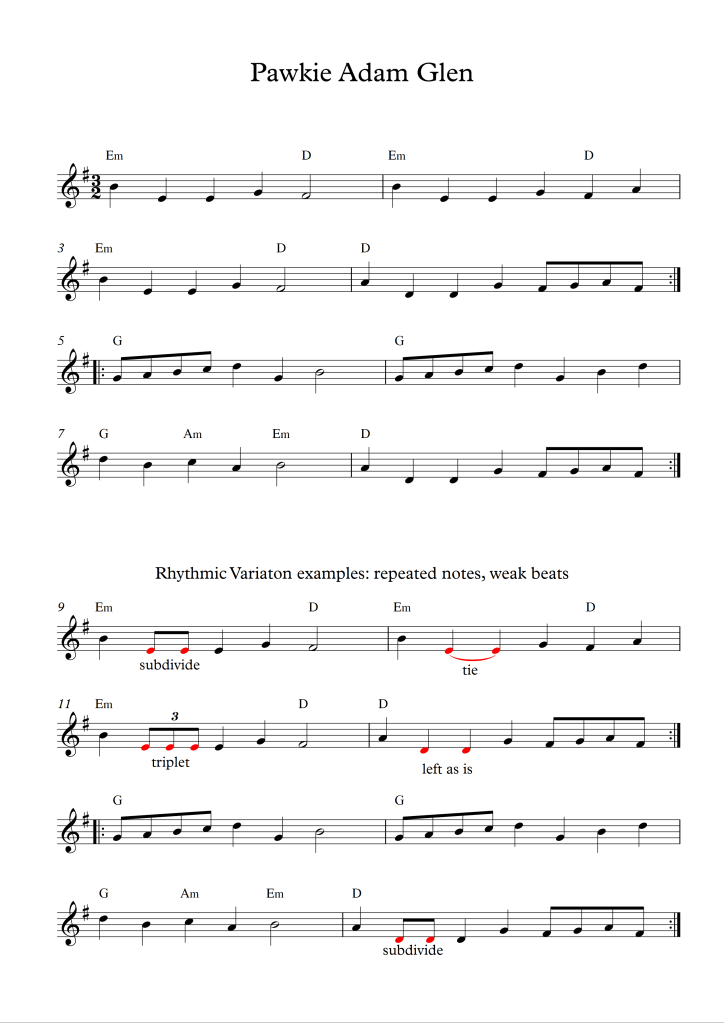
Try adding the turns and triplets that we’ve been using recently in places where the melody moves by step, and look out for places where there are repeated notes – we will try some things out with those next time!
Here’s the Cumberland Waltz from, surprisingly enough, Cumberland. It was recorded in the 1950’s by Robert Forrester and Norman Alford, along with other songs and tunes from the area, on an album called ‘Pass the Jug Round’. This is available on Apple Music, and is worth looking up!
Here’s a slower and faster run through of the tune:
Here are the dots with the slightly more interesting chords that we tried out – who doesn’t love a walking bass line?
You might want to try some turns in places where the melody moves downwards by step or by a small interval such as a 3rd, good places to start might be bars 4-5 or bars 21-24. As a challenge, try adding up to three turns in the A section and maybe four in the B section. The effect of this ornament is to emphasize where the melody moves smoothly – sometimes less is more so try them wherever they might fit and then chose just a few places for each time through! Here’s a video on turns to refresh your memory:
This is one of my favourite slipjigs, the fabulously named Trip to Marrowbones, also known as Four Bare Legs Together and as The Raking Quality. It comes from the 1770 Northumbrian manuscript from William Vickers. This is the F major version, there is another where most of the Fs become F sharps, taking the tune into G minor. We recorded this G minor version for the Stepling album as part of our ‘Saucy Set’, this can be found here at 1:35. For clarity I’ll not post the dots for that version just yet, I think we need to let the major version settle first! I had thought that I had learned this from an Eliza Carthy and Nancy Kerr album, but this doesn’t seem to be the case – goodness knows where it came from!
Here are the dots, with filled-out chords, PDF can be found here:
With Burns night approaching, it seemed appropriate to learn a Scottish tune; this tune dates back to at least the early 1700s, remaining popular for quite some time as it was used in several ballad operas in the 18th century as well as being used as a retreat march by the British military, specifically by the 37th Regiment. It was printed in many books across Scotland as well as making its way into a few English books too.
The PDF can be found here. We used two basic accompanying rhythms for the drums and guitars:
Here is the piece we learned on Monday 11th November, Carol of the Bells. This was arranged by Ukrainian composer Mykola Leontovych in 1914, based on a Ukrainian folk chant called ‘Shchedryk’. We divided the piece into four phrases – phrases one and two can be played simultaneouly and with the bass line. The structure is pretty free at the moment, with everyone following my hand signals, we might formalise it later.
Here is the Dusty Miller, a fantastic 3/2 hornpipe first published in England in 1718 – it seems to have been very popular in the 1700s and early 1800s in England and Scotland in particular, and it also made its way to Ireland and America.
Here’s the video of the tune:
Here are the videos for the close harmony (2nd line of each system of the music):
…and the independent harmony (3rd line of each system of the music):
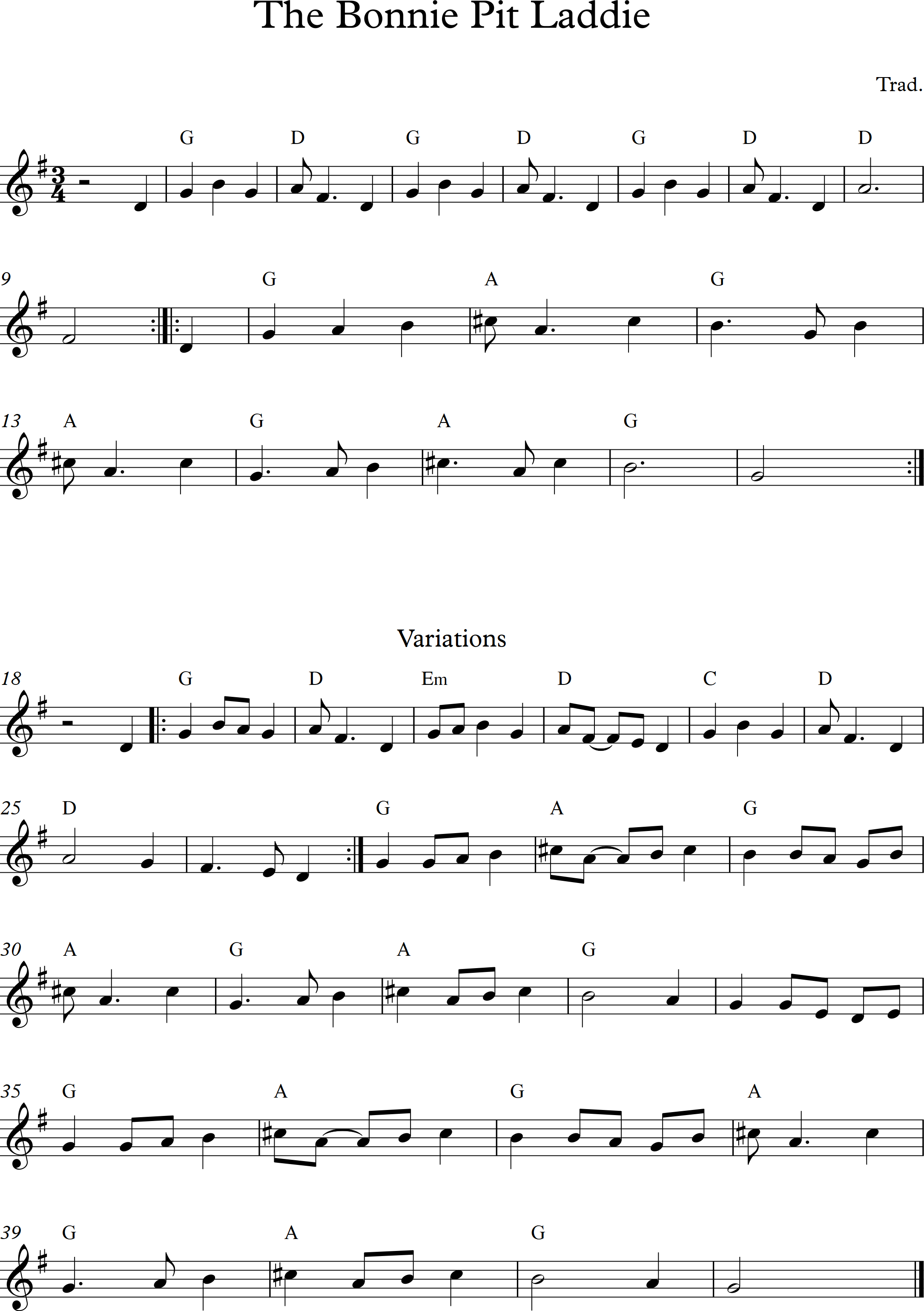
Here’s the video of The Bonny Pit Laddie, a song/tune from Northumbria, printed in the 1882 Northumbrian Minstrelsy, with earlier versions printed elsewhere in 1812 and 1770.
In the version I know, each line is sung twice, meaning that you’ll get through the tune twice, but in others I’ve found the second and fourth lines are follow one another making up one B section:
The bonnie pit laddie, the canny pit laddie, the bonnie pit laddie for me, oh (x 2)
He sits in a hole as black as the coal and brings the bright silver for me, oh (x 2)
The bonnie pit laddie, the canny pit laddie, the bonnie pit laddie for me, oh (x 2)
He sits on his cracket & hews in his jacket & brings the bright silver for me, oh (x 2)
The pit in question would have been a coal mine, and the ‘bright silver’ refers to money earned. For those of you in education, or for anyone who wants to know more about mining songs, there is a great digital info pack available from the EFDSS website here.
Here is the video for this week’s tune, Sussex Waltz. It first appears in print as ‘Untitled Waltz’ in the 1800 Welch manuscript from Bosham in Sussex.
Here are the dots for the tune, with a PDF file here:
For a version with some variations and ornaments, and with an alternative chord sequence in the B part, here.