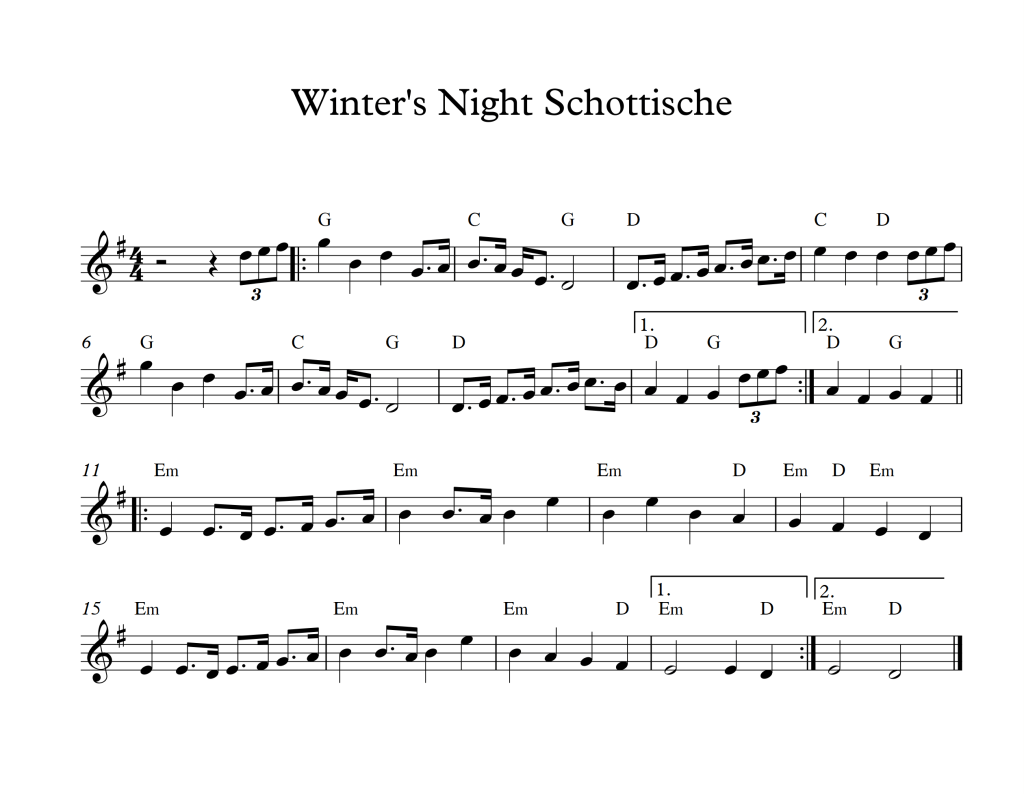
Here is a tune that goes by many titles: Rainbow Schottische, Stephen Baldwin’s Schottische and Midnight Schottische. It appears in Kerr’s Merry Melodies book of 1870 and appears to have remained popular ever since in England, Scotland, Ireland and North America.
We added some turns and/ore triplets in places where the melody moves by step but otherwise kept ornamentation and variation to a minimum.
Here is a video with slower and faster versions of the tune:
Here’s a fantastic polka from Ireland, first published in 1858. It has many, many titles, including The Grand Old Woman, The Half Door, Lisdoonvarna Polka, London Bridge Polka and Leather The Bottle. A wattle is a stick or truncheon.
Here is a video with a slower and a faster run through:
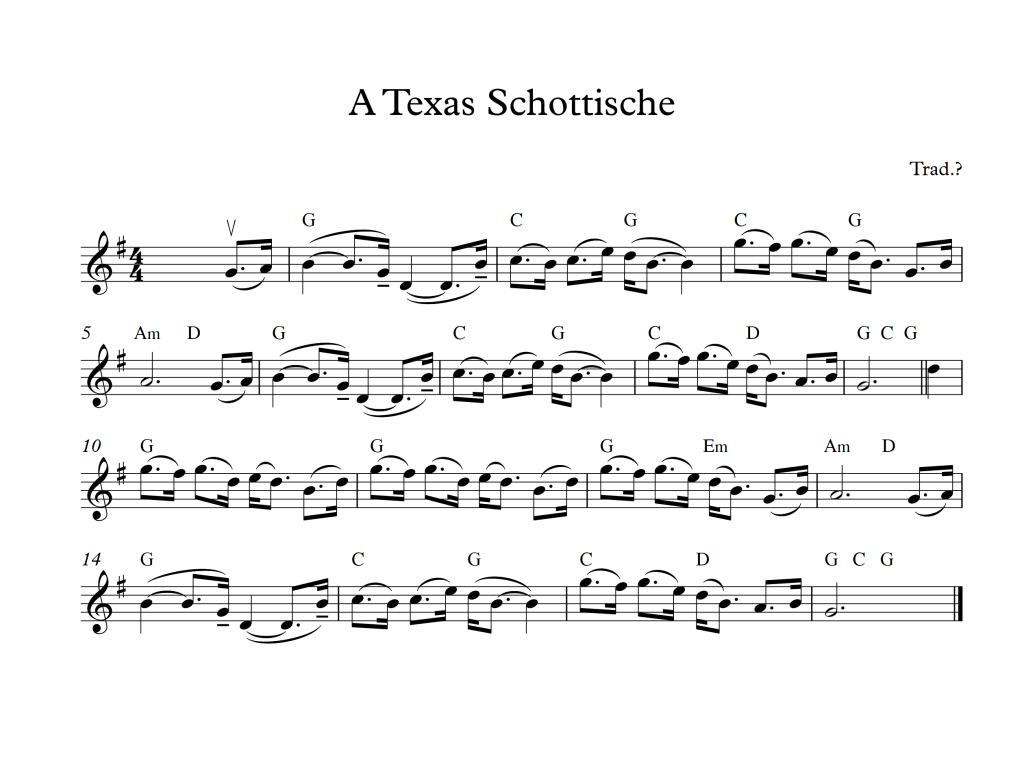
Here we have one of my favourite schottisches, which I know as Texas Schottische – it’s not the more famous The Texas Schottische, which is a quite different tune, so I have decided to tweak the title to A Texas Schottische to avoid confusion. A Schottische is a kind of slow polka originating in Bohemia and becoming popular in the Victorian era.
I know this tune from playing for one particular (now defunct) ceilidh band however, I can’t find this tune anywhere else, under this or any other title! I suspect that the title may have been assigned incorrectly, that perhaps it was in a set with the more famous Texas Shottische but a search of Apple Music, Google Play, Spotify etc hasn’t shed any light on the issue, and searches in the Vaughn Williams Library, on Folktunefinder.com and on various other online resources have proved fruitless.
It’s still a cracking tune, and I hope you enjoy it. Here is a video play through:
And here are the dots, with suggested bowing for the fiddle players since the long-short-long-short pattern can cause difficulties. We added single cuts below the first B in bar one of the A section (demonstrated in the video), you might also try adding a single cut above the top Gs in the B section.
The ideas used here are the same or similar to those used in Rattle in Cash. This is mostly because the tunes were chosen for their similar melodic shapes, so that they would be good companions – note the removed notes in bar 13 to mirror the same rhythmic feature in Rattle the Cash.
A ‘fidget’ is a note added in between repeated notes, either a step above/below the repeated notes, or a third above/below (a ‘skip’). The scale is a connecting note added in between notes that are a skip (or a third) apart. I’ve written an example below to demonstrate how these might be applied to this tune, averaging one variation per two bar phrase, but try out these ideas in other places to find what works for you.
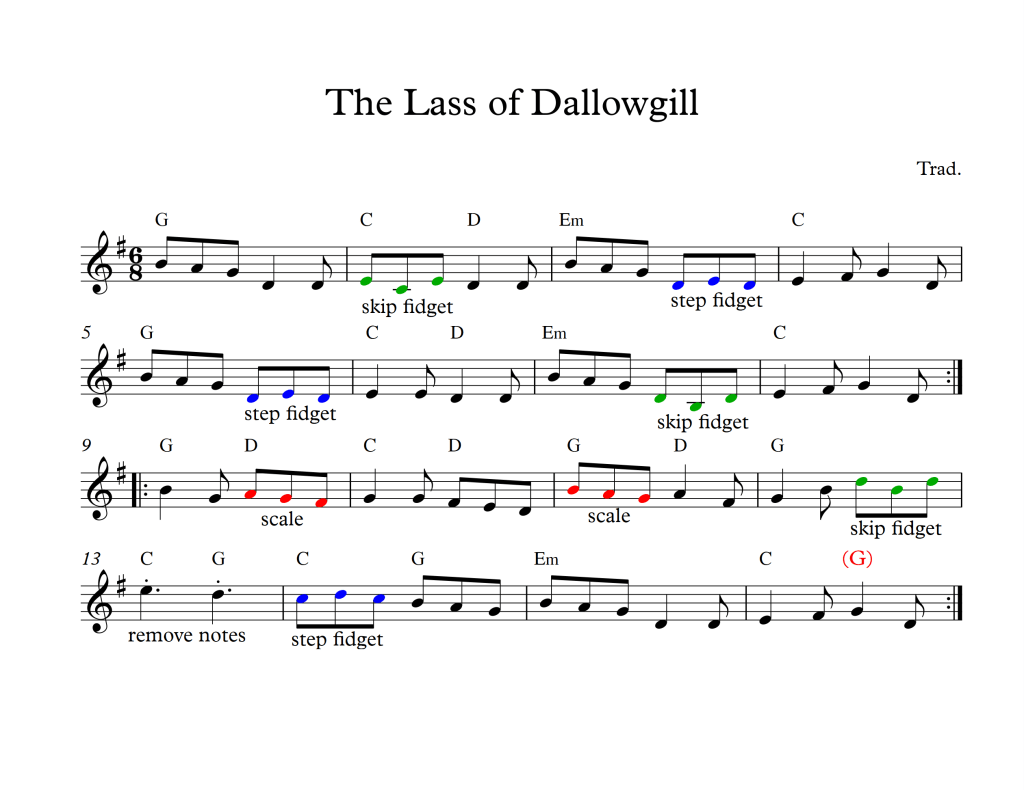
Here is a jig to go with Rattle the Cash; The Lass of Dallowgill aka The North Skelton Sword Dance. Dallowgill is near Rippon in Yorkshire, and I’ve found references to the tune from around 1914, though it may go back further than that. Here are the dots:
And here is a run through of the tune, slowly at first and then at a more lively pace:
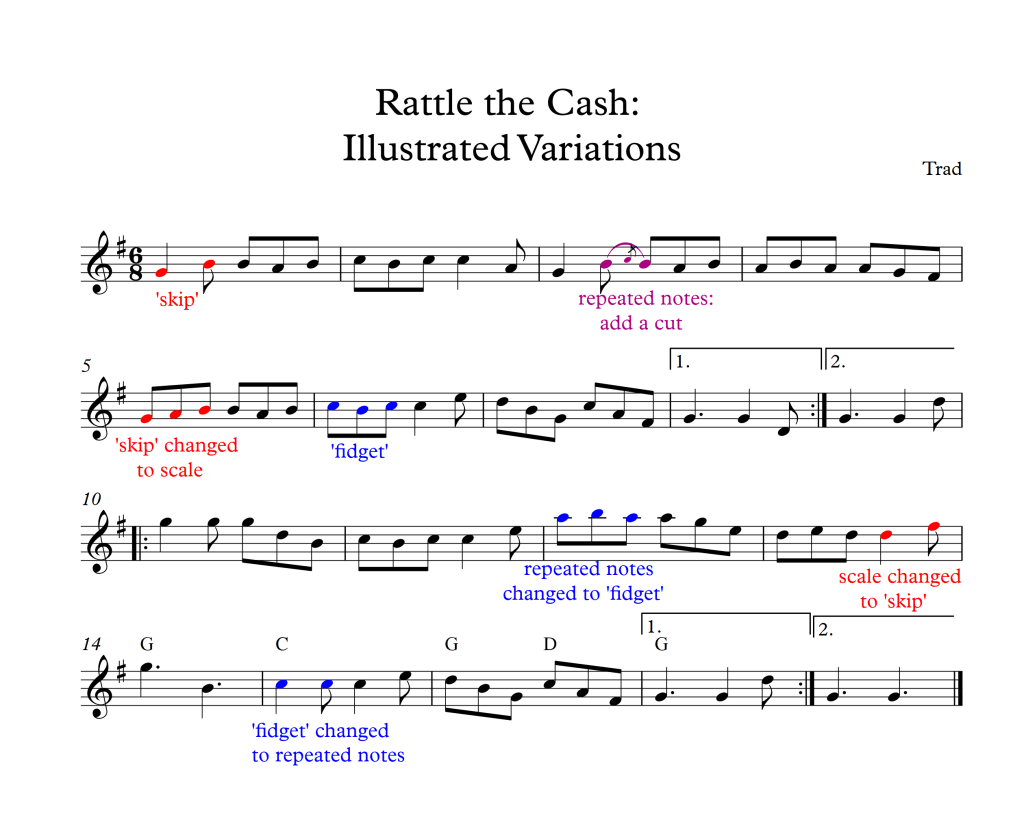
We looked at three main ideas for varying Rattle the Cash, which are all applicable to other jigs. Firstly, looking for ‘skips’, aka intervals of a third – you can add the note in the middle to make a scale, smoothing out the melody. Or, vice versa, take the middle note out of a scale to make the tune more bouncy. Secondly, look for ‘fidgets’, aka auxiliary notes – take out the middle note for make the tune bouncier or add a fidget note in between two repeated notes to make the tune smoother. Lastly, we tried adding a ‘cut’ ornament in between repeated notes. This works best when you keep the repeated notes in the same bow/breath/bellow direction.
Here is an annotated copy of the tune, to demonstrate how these can be applied. I’d recommend trying one idea per two bar phrase, so that the tune doesn’t become too busy.
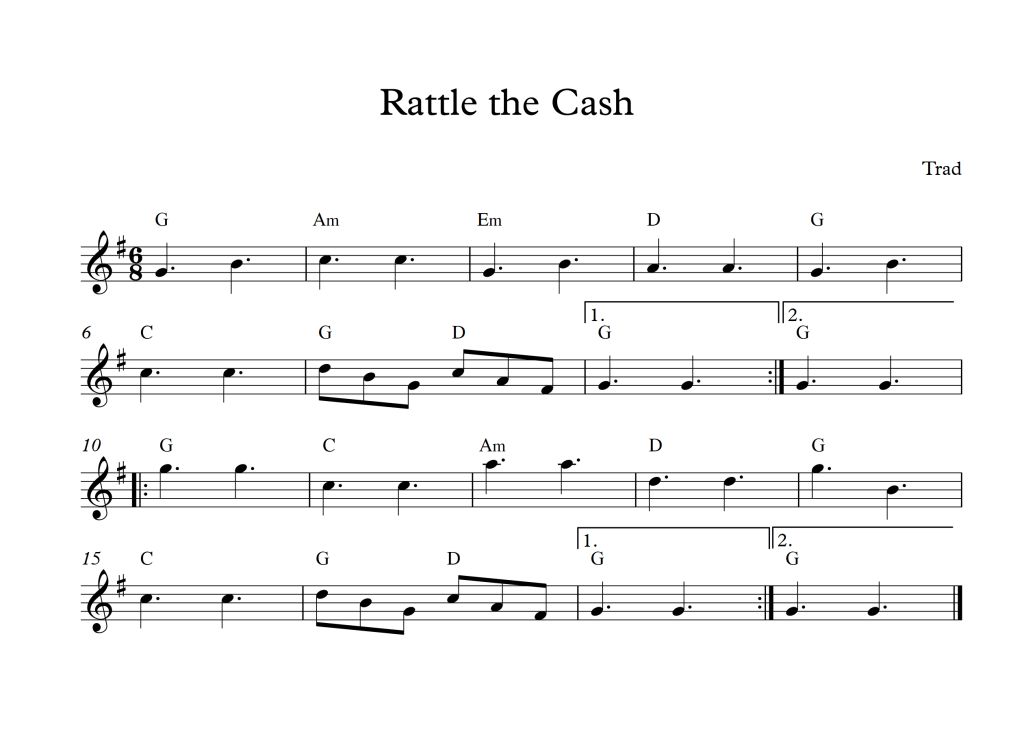
Here is the tune from Monday 19th April. Rattle the Cash is a tune I know from Chris Bartram’s fantastic English Fiddle book.
We started with a skeleton version of the tune, to see the basic structure and repeated patterns of the melody.
We then filled in the melody with scale and arpeggio shapes and with ‘fidget’ shapes (as in the beginning of bar 2). We’ll explore these in more detail next week.
We looked at several ideas for varying the tune, using specific musical landmarks:
Repeated notes – here we tried two different ways of varying the tune. The first option was to combine or tie repeated notes together to create a longer note. This is demonstrated in bar six of the example. The second idea was to insert a ‘fidget’ in between repeated notes, this being a note that it a step higher or lower than the repeated notes. The technical term for these is ‘auxiliary notes’ but I prefer the term fidget as it indicates a reluctance to sit still on one note for too long! These are demonstrated in bar one of the example.
Descending scales – these are often a good place to put a turn, or alternatively a triplet, as these emphasise the smoothness of the melody.
Scales in general – here we added some pedal notes, as demonstrated in bar 12. This is where a note is repeated or held, while the harmony in other parts changes. In this tune, you can try holding or repeating an A in the section from bar 10 to bar 13.
Skips, or thirds – wherever you have an interval of a third (e.g. D to F#), you might consider adding a passing note in between (e.g. to make D E F#). An example can be seen in bar 2.
The idea in general is to experiment with these ideas, and to find the combinations that you like and that work for you on your specific instrument. I’d suggest focusing on one idea at a time and getting comfortable with that before trying the next, and ultimately limiting yourself to a couple of variations per phrase – sometimes less is more! Exploring and experimenting with the tune in this way also helps to internalise and memorise it.
Here is the video and dots for The Munster Cloak, also known as The Spanish Cloak and An Fhallaingin Mhuimhneach. I haven’t been able to find out much about it; it only seems to appear in manuscripts from the 1960s onwards and there is some suggestion that it originated in Spain, with comparisons drawn to a melody by Spanish composer Enrique Granados (1867-1916). I’ve put a video of this tune at the bottom of the post so you can draw your own conclusions, but I would always resist the urge to fill in the gaps – it’s a tune that’s in the Irish tradition, and it’s gorgeous!
The third in our trilogy of 3/2 hornpipes – this three-part hornpipe, first published in 1742, has some similar musical figures to the previous 3/2 tunes covered recently and follows on rather nicely from the Rusty Gulley.
Here is a video with a slow and a faster play through, with another faster play through courtesy of Spiers and Boden:
Next week, we’ll apply some of our 3/2 variation ideas to this tune, and try all three tunes together in a set (Pawkie Adam Glen/Rusty Gulley/Old Lancashire Hornpipe).





 New Ealing Sessions