Here’s Monday 21st’s tune, a jig from Shetland called The Foula Reel, aka Da Shaalds o Foula, or Boanie Tammie Scollay. It’s a pentatonic (five note) tune that’s deceptively simple and repetitive!
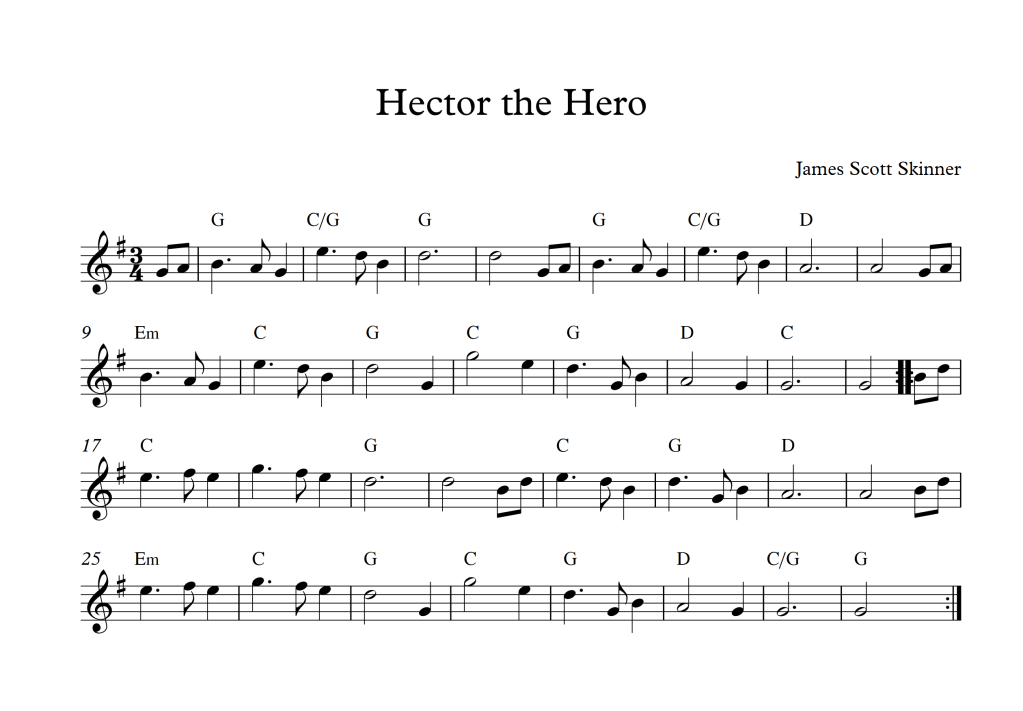
Monday 28th’s tune is Hector the Hero by James Scott Skinner. Written in 1903, the tune was composed as a tribute to Major General Sir Hector MacDonald (1857-1903), a celebrated and decorated military officer who died of suicide following public accusations of homosexuality. Scott Skinner’s tune has remained popular since it’s composition.
Here is a video of the tune, with a slow and plain version followed by a faster and more decorated version of the tune.
Here is the download of this tune, and a second version with suggestions of bowing, variation and ornamentation.
and as a little extra, here’s the E5 chord for the ukulele players!
Finally, I’ve done a simplified version of the tune here, essentially removing a few (but not all of) of the trickier rhythms, for anyone who would like it:
Here is the A part of Monday 17th’s tune, Gille-Callum, aka Gillie Callum, The Cutty Spoon or The Lad Malcolm amongst other names. It’s a Scottish strathspey that dates back to the mid-1700s, a strathspey being a slow dance in 4/4, with the tune named for the dance form and normally containing characteristic Scottish ‘snap’rhythms. This is quite a challenging tune type, so give yourself time to get used to the rhythms and the techniques for producing them.
Here are the dots, with a notation of how we divided the rhythm in order to learn it:
Here is a demo of the A section with a suggestion of how to practise this rhythm:
Here is a video for the fiddle players on how to achieve the Scottish ‘snap’ rhythms, with some bow exercises to help:
PDF of the chords (a PDF of the full tune will follow when we’ve learned the whole thing):
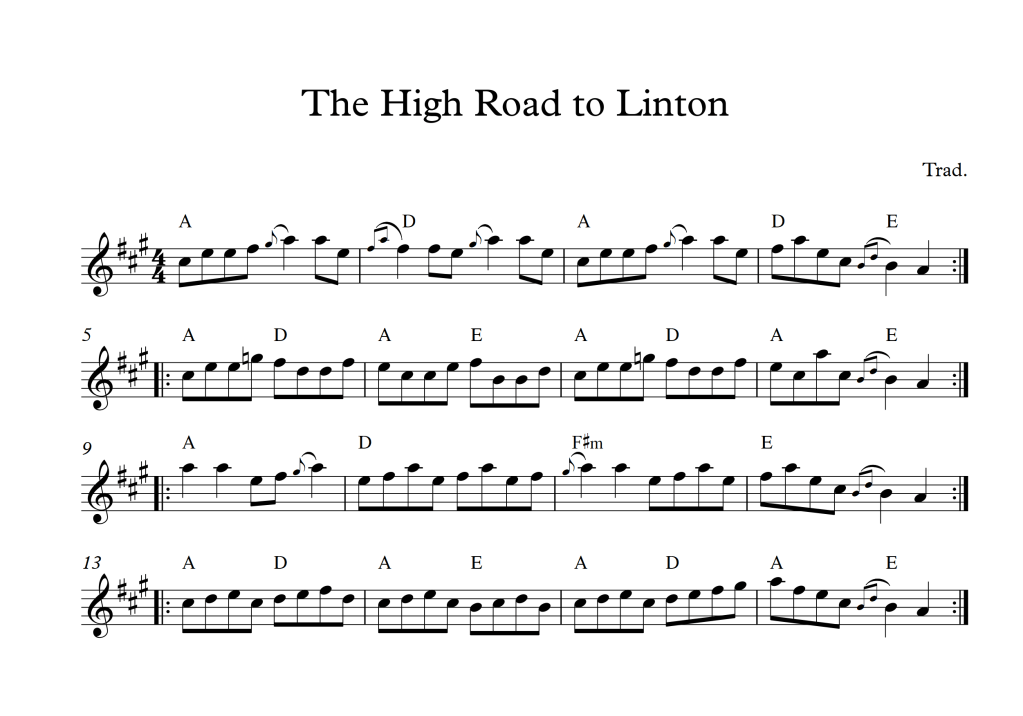
Here is Monday 10th’s tune, The High Road to Linton. This tune is in Scottish, Irish, north eastern English and Canadian traditions, and was first published in 1794. It’s also known as Cuddle in a Boasie, Leinster High Road and Quadrille du Bucherons as well as various other titles including the word Linton, such as Jenny’s Gone to Linton.
There are various towns and villages across the British Isles called Linton – given the areas in which the tune was collected and published, I’m going to guess that the Linton in question is either the one near Morpeth or the one near Jedburgh, either way around the Scottish/English border.
It has four parts, of which we’ve learned three so far – I have included all four parts here but don’t feel obliged to learn the fourth part, we will cover it next week! Here is a video with the single cuts and double cuts, and the rhythmic emphasis we discussed. There is a PDF beneath with some examples of bowing available too.
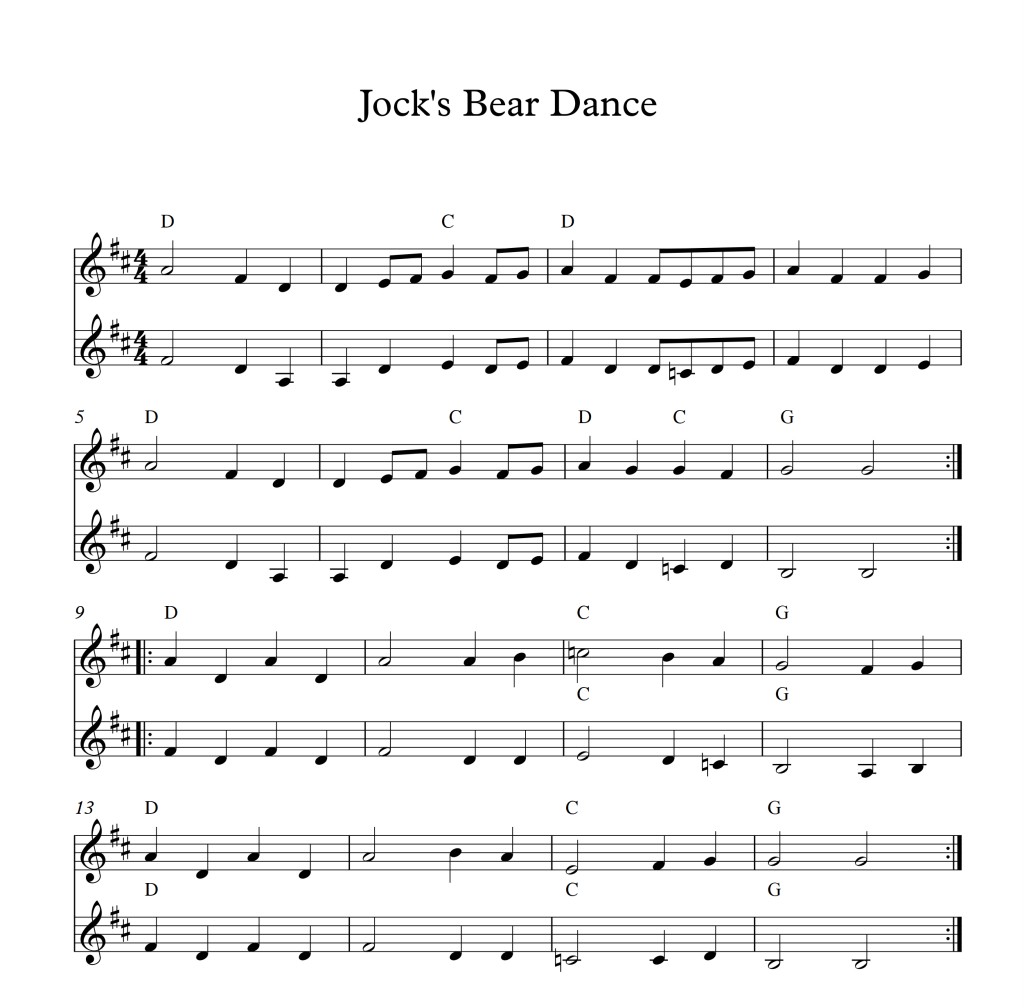
Our last tune of the year, Jock’s Bear Dance, with an added harmony and rhythmic accompaniment. The purpose of the accompaniment is drive the tune, making it feel lively even though it’s not that fast. Here are the dots (with apologies to the whistle players for the low notes! The video below shows a couple of ways the tune, harmony and rhythmic accompaniment can be played to make an arrangement.
We’re finished for this term now, I hope everyone has a great Christmas and New Year. We’ll return on January 10th – whether this is in person or online remains to be seen, we’ll see what the regulations and recommendations are in the new year.
Here is another French tune that I know as Jock’s Bear Dance, having learned it from fiddler Jock Tyldesley. It also comes up as ‘Branle de Bourgogne’, a branle being a type of dance that dates back to 16th century France. Again, we added turns in places where the melody moves by step or in skips.
Here is Monday 29th November’s tune, La Roulante, by French musician Jean Blanchard. It’s in mixolydian mode, so a major mode with a flattened seventh, in this case D major with C naturals, and has a lovely syncopated feel in the B music. We tried adding turns in places where the melody moves by step or in skips.
Here are the dots, with a PDF and video underneath:
Here is the tune from November 15th, another Irish tune to go in a set with Lilting Banshee. Look for the fidget shapes to add rolls (highlighted example in blue), and for the crotchet-quaver rhythm moving by step (highlighted in red) for adding turns. Some of the turns work better on the fiddle and others work better on wind instruments – try the notated version in the PDF and see which ones work for you.
Here are the dots:
Here is a PDF with some more ornaments written in: