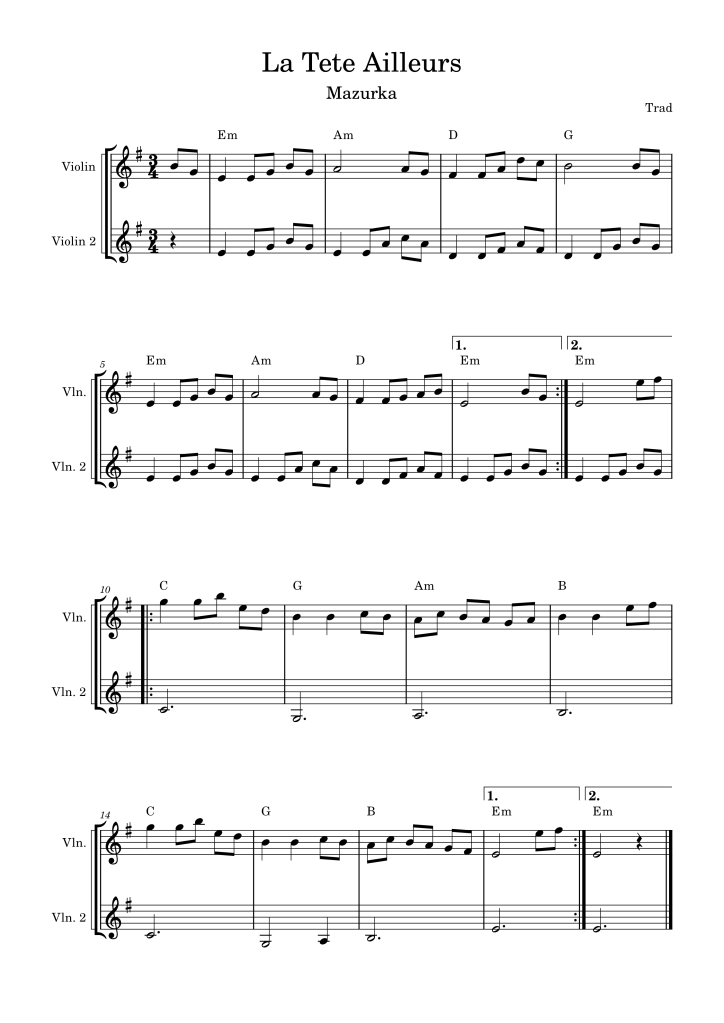
In order to create an accompanying pattern for our recent tunes in 3, we took inspiration from the melodic pattern in bar one of La Tete Ailleurs. This is essentially an E minor triad (three note chord) so we played it and then transposed the pattern for each chord in the piece, starting on an A for the A minor chord, a D for the D major chord etc.
We then took things up a notch, changing the inversions of the triads to keep the patterns a similar register. What’s an inversion? It’s the order in which you play the notes, for instance an A minor triad is ACE in root position, CEA in first inversion and EAC in second inversion. Below is a version that uses root and second inversion chords to create a part that flows.
We switched to long notes in the B section to vary the texture, choosing the root note of each chord.
Deborah is a violinist and violist specialising in English folk music. She trained in viola and Baroque viola at Birmingham Conservatoire, before returning to her first love of traditional music, song and dance.
Deborah has developed a passion for playing for dancing since joining her first ceilidh band at age 13. She is a member of Stepling, a band performing English music, step-dance, song and percussion, and also plays with Folk Dance Remixed, a dance company combining traditional dance with hip hop and street dance styles, with whom she has performed as such events as Car Fest, the Southbank's Festival of Love and Glasgow's Commonwealth Games Festival.
Deborah records on a regular basis for a number of people, including The Mystery Fax Machine Orchestra, and for Laurel Swift's 'Travelling with Thomas' musical.
She teaches music, song and dance regularly for The English Folk Dance and Song Society, as well as on a freelance basis for various workshop series, festivals and music services. Deborah recently completed The Teaching Musician MA degree course at Trinity Laban, graduating with Distinction.
View all posts by debfiddle

 New Ealing Sessions